
Walk out onto a deck that’s been sealed wrong, and you’ll know it. The boards feel soft underfoot. The stain is peeling at the edges. There’s that gray, sun-beaten look that no amount of cleaning fixes. Working on decks across North Carolina, we see this constantly, and almost every time, it comes back to one of two things: the wrong product for the wood, or the right product applied at the wrong time.
Here’s the answer upfront.
For most pressure-treated wood decks in a humid Southern climate, a penetrating oil-based semi-transparent stain outperforms everything else. For older, heavily weathered decks, solid stains are the better call. Clear sealers work well on new wood only.
The Four Types Worth Understanding First
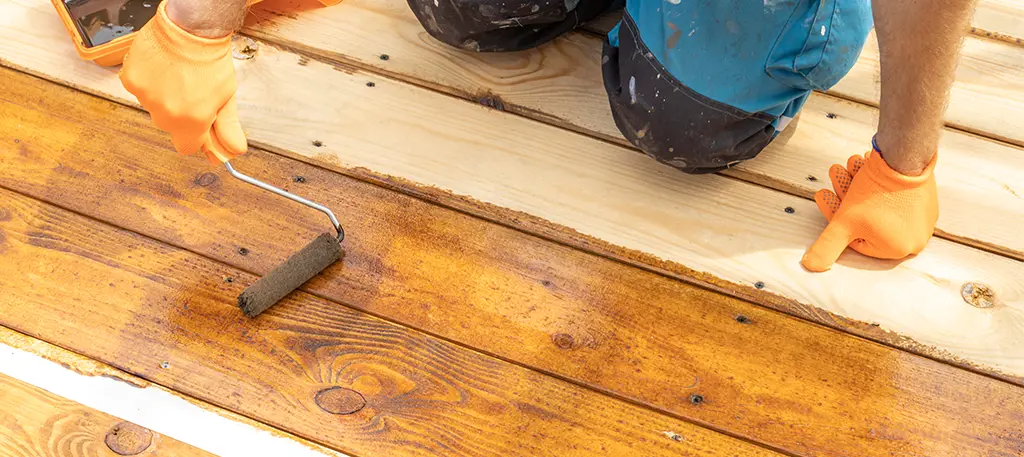
Before the product list means anything, you need to know what each type actually does.
Clear deck sealers sit lightest on the wood. They let the natural wood grain breathe, block water penetration, and are the right call for new wood. The trade-off is UV protection, which is genuinely weak in most clear formulas.
Semi-transparent stains add color while keeping the grain visible. They penetrate into wood fibers rather than sitting on top, which means they don’t peel the way surface-film products can. Good on pressure-treated wood or a deck that has some weathering but isn’t in rough shape.
Semi-solid stains are denser, cover more of the grain, and hold up better on boards that have seen a few hard seasons. Still a penetrating formula, but with richer pigment.
Solid stains work like deck paint in their coverage. The wood grain disappears entirely. They’re the strongest option for UV protection and moisture resistance, and the right move when the existing deck has real damage you’re trying to mask and protect.
One thing worth knowing before you pick any of them: the EPA maintains guidelines on what qualifies as a registered wood preservative, and not every product marketed as a “sealer” meets that standard. That distinction matters for long-term protection.
The 7 Best Deck Cleaners for Mold Removal
1. Thompson’s WaterSeal
Thompson’s WaterSeal is the most recognizable name in clear sealers, and for new wood in partial shade it does its job. On a deck sitting in full sun all afternoon, the UV exposure catches up within a season.
2. Ready Seal
Ready Seal earns its following among contractors for practical reasons. It’s an oil-based penetrating formula that requires no primer, goes on forgiving if you overlap, and holds up well through humidity swings. The downside is dry time, sometimes 72 hours in humid conditions before you can put furniture back.
3. Armstrong Clark
Armstrong Clark doesn’t appear in most big-box stores, but both the semi-transparent and semi-solid versions perform at a level that’s hard to argue with. Excellent UV resistance and solid performance through temperature extremes. The cost is higher than mass-market options.
4. TWP 1500 Series
TWP 1500 Series is the only EPA-registered wood preservative stain on this list, which matters if mold and mildew resistance is your main concern. It performs best on cedar and redwood, and the odor during application is strong. Cleanup requires solvents. Worth the prep if the wood quality is there.
5. Defy Extreme
Defy Extreme is where water-based sealers start to compete seriously with oil-based ones. The zinc nano-particle formula handles UV rays better than most water-based stains, and it holds up in high humidity without the fumes or long dry times. Dense or heavily damaged wood still responds better to oil-based formulas.
6. BEHR Premium Transparent
BEHR Premium Transparent is an accessible, easy-to-apply option for a deck that’s fundamentally in good shape and needs a refresh rather than a rescue. Skips the separate sealer step, applies cleanly, and fades faster than oil-based products on decks in direct sunlight.
7. Cabot Australian Timber Oil
Cabot Australian Timber Oil exists for one purpose: hardwoods that standard sealers can’t properly penetrate. Ipe, teak, and mahogany need something that feeds the wood’s natural oils, and Cabot does that. On a standard pressure treated pine deck, there’s no reason to use it.
8. Olympic Maximum solid stain
Olympic Maximum solid stain is what you reach for when the deck has turned gray, the wood grain is gone anyway, and you need real coverage plus protection. The built-in primer simplifies prep. It hides damage well and delivers solid UV resistance.
What Goes Wrong More Often Than the Product Choice
Temperature and timing cause more failures than product quality. Most sealers apply between 50 and 90 degrees Fahrenheit, away from direct sunlight. New pressure-treated lumber off the kiln should weather for several months before any stain goes down. Old coating that’s already peeling needs to come off completely. Applying a second coat over failing material traps moisture underneath instead of sealing it out.
Curious how solid and semi-transparent options stack up in more detail? Our guide on solid deck stain covers that comparison thoroughly. And if you’re weighing wood against composite for the deck itself, this piece on composite decking is worth reading before you commit. We also have a full breakdown of oil vs. water-based deck stains if that decision is still unclear.
FAQ
How long do deck sealers actually last?
One to three years in most cases. Full-sun decks on the shorter end, shaded decks on the longer end. Foot traffic and prep quality matter too.
Do I need to strip old stain before reapplying?
If the old coating is peeling or flaking, yes. Applying new stain over failing old stain creates a moisture trap. If the old stain is worn but still bonded, light cleaning is usually enough.
Can I use these products on composite decking?
No. Composite decking does not need sealing or staining. Using penetrating formulas on composite can damage the surface.
Maybe Skip the Weekend Project
Sealing a deck properly takes prep work, correct timing, two coats applied right, and the knowledge to spot what’s cosmetic versus what’s structural. If the deck has soft boards, sagging areas, or loose railings, a sealer is the wrong starting point.
If you’d rather have someone who does this every week handle it, our deck repair services cover everything from surface restoration to structural fixes. Call us at (910) 985-5199 or message us here.