
Pressure-treated lumber has been the most common decking material in the country for roughly forty years. For a lot of homeowners, it still makes sense.
For others, it quietly turns into the wrong call about three summers in, when the maintenance schedule catches up with them. Whether it belongs on your deck depends on a handful of specific questions about your yard, your time, your budget, and how long you plan to be in the house. I’ll walk you through what the material genuinely does well, where it falls short, and how to figure out which side of that line your project sits on.
First, a Reality Check on What This Stuff Even Is
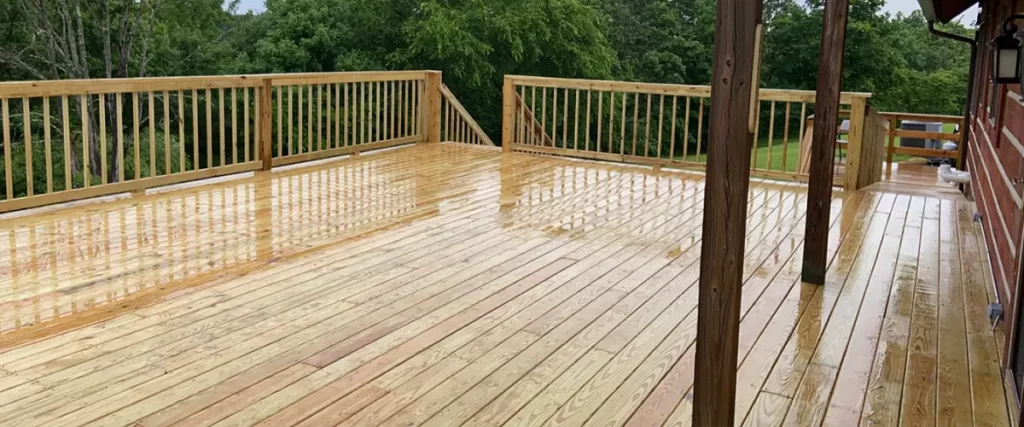
Pressure-treated lumber starts its life as ordinary Southern Yellow Pine, the same wood that frames roughly half the houses in the eastern United States. What makes it “pressure-treated” is what happens next.
The boards get loaded into massive sealed cylinders the size of subway tunnels, the air gets vacuumed out, and a preservative solution gets forced into the wood under enormous pressure. The chemicals don’t sit on the surface. They live inside the cells.
That treatment is what turns a board that would rot in two years into one that can sit outside for two decades. The preservative chemistry has changed considerably over the years. The arsenic-based formulations your grandfather’s deck might have used haven’t been sold for residential purposes since 2003, when the EPA’s restrictions on chromated arsenicals took effect. Today’s pressure-treated decking uses copper-based preservatives that are considered safe for residential outdoor use, including around vegetable gardens and family pets.
The Reasons People Keep Picking It
I’ll be straight with you. Pressure-treated decking has not stayed popular by accident. It’s popular because it does specific things well.
The most obvious is price. A pressure-treated deck typically costs somewhere between a third and half of what you’d spend on composite, and a small fraction of what tropical hardwoods run. For a homeowner trying to build a 500 square foot deck without taking out a second loan, that gap isn’t a minor detail. It’s often the difference between building this summer and waiting another year.
There’s also something to be said for how forgiving the material is. You can stain it any color you want. You can change that color a decade later. You can replace a single damaged board on a Saturday afternoon with a piece you grabbed from any lumberyard in the country, for under twenty dollars, with zero special-order waiting. Composite decking can’t do any of that.
And, frankly, pressure-treated lumber is strong. Southern Yellow Pine is dense and structurally tough, which is part of why it’s also used for the framing underneath nearly every deck regardless of what the surface boards are made of. You’re not making a fragile choice.
The Reasons Other People Walk Away
And then there’s the other side, which deserves equal honesty.
Pressure-treated decking is a maintenance commitment. It needs cleaning. It needs resealing or staining every two to three years. If you let that schedule slip, the boards gray, then crack, then splinter, then start looking sad in a way that’s hard to come back from without significant work.
The wood also moves. A lot, at first. Fresh pressure-treated lumber is loaded with moisture from the treatment process, and as it dries out on your deck through its first summer, it warps and twists and checks. Good installation manages this, but it can’t prevent it. Your beautifully flat deck in May might have visible cupping in some boards by August. That settles down over time, but the first year is the first year.
Splintering is the complaint we hear most often from homeowners who eventually replace their pressure-treated decks with composite. Older boards that haven’t been maintained well can become genuinely uncomfortable for bare feet, kids, and pets.
The Quick Side-By-Side
For people who think better in tables, here’s how it stacks against the main alternatives.
| Material | Price | Maintenance | Lifespan | Best For |
| Pressure-Treated Pine | $ | High | 15-25 years | Budget-conscious builds, large decks, and custom stain colors |
| Cedar | $$ | Medium | 15-20 years | Natural look, lower maintenance than PT |
| Composite | $$$ | Very low | 25-30 years | Set-it-and-forget-it ownership |
| Capped Polymer (PVC) | $$$$ | Minimal | 30+ years | Pool decks, full sun exposure, no-maintenance preference |
| Tropical Hardwood | $$$$ | Low | 40+ years | Premium projects, hardwood aesthetics |
A Few Scenarios Where Pressure-Treated Wins Outright
There’s a reasonable instinct to assume the more expensive material is always the better choice. It isn’t. Pressure-treated decking is genuinely the right answer in several real situations.
If you’re building a large deck and your budget is firm, pressure-treated lumber lets you actually finish the project rather than scaling it down to fit composite pricing. If you want a specific custom stain color that no composite manufacturer makes, pressure-treated wood gives you exactly that flexibility. If you’re staying in the home for under ten years, the longer life of the composite may not pay back the price gap before you sell.
And if you actually enjoy spending an afternoon every couple of years with a sprayer and a can of stain, the maintenance isn’t a burden; it’s just deck ownership.

A Few Scenarios Where It Probably Isn’t
The opposite is also worth being clear about.
If your deck will be in direct full-day sun without any shade, pressure-treated boards will fade and dry out faster than the maintenance schedule can reasonably keep up with. If you have small kids or dogs who’ll spend serious time on the deck, the splintering question is going to come up eventually.
If you’re someone who genuinely can’t see yourself maintaining the surface every two to three years, you’ll regret the choice within a decade. And if the deck is highly visible from your main living space and aesthetics matter substantially to you, capped composites or hardwoods deliver a finished look that pressure-treated lumber can’t really match.
What Homeowners Actually Ask Us
How long will a pressure-treated deck really last?
With consistent maintenance, twenty to twenty-five years. Without maintenance, expect to be looking at replacement around year twelve.
When can I stain a brand-new pressure-treated deck?
Usually thirty to ninety days after installation, depending on weather and the moisture content of the boards when they arrived. The wood needs to dry enough to accept stain properly.
What fasteners should be used with modern pressure-treated lumber?
Stainless steel or hot-dipped galvanized. The copper in modern treatments corrodes standard fasteners surprisingly fast.
Will treated wood off-gas chemicals into my yard?
Modern copper-based treatments are bound into the wood structure and considered safe for residential use, including around gardens and pets.
Can I build a hot tub deck with pressure-treated lumber?
You can, with proper structural engineering for the weight load. The wood holds up well in moist environments, which is part of why it’s still popular for deck applications generally.
What Most People Do at This Point
Here’s the thing about decking research. You can spend a weekend reading every comparison article on the internet and you’ll still be staring at the same question. Is pressure-treated lumber right for my deck, my yard, my budget, my family, the next twenty years? That question doesn’t get answered by another spreadsheet. It gets answered by someone who has built dozens of decks walking your yard with you and giving you a real recommendation.
Call us at (910) 985-5199 or message us here. We’ll take a look at the space, talk through the trade-offs honestly, and help you decide what actually fits. The full breakdown of how we handle deck building is sitting on the service page if you want to read more before reaching out.